Why your hosting choice matters
Building an Oracle APEX app is the easy part. Deciding where it will run in production is where many projects stall.
APEX is a no-cost feature of Oracle Database, so the real decision is about the database and the web tier around it: who installs it, patches it, backs it up and answers the phone when it stops. Each option below trades money for control in a different way.
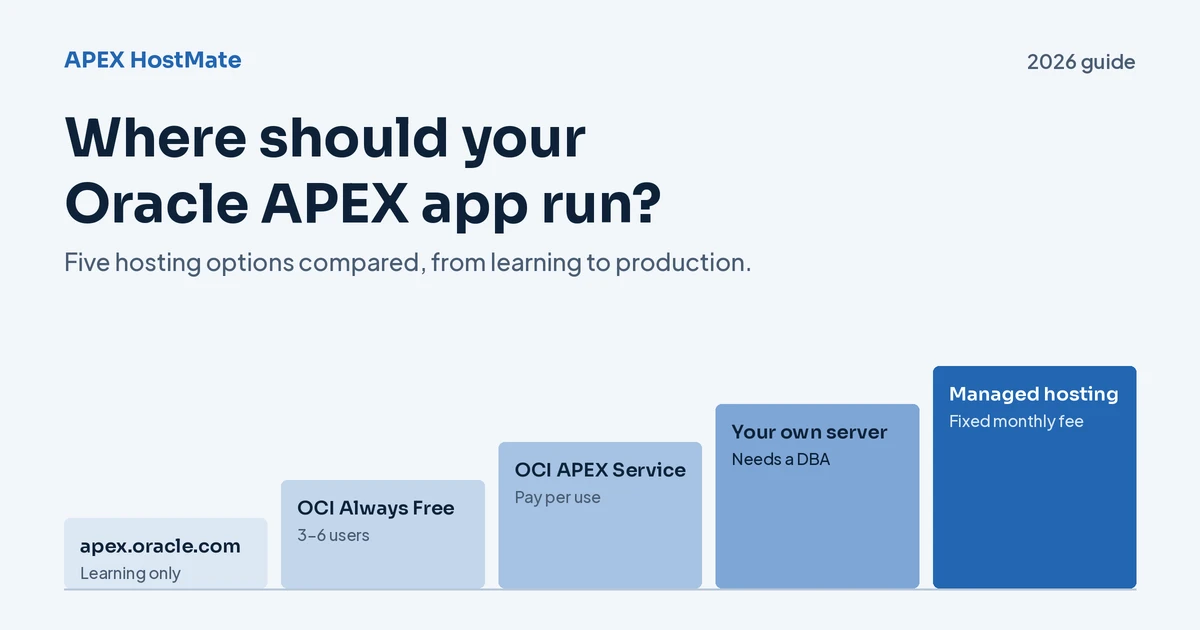
This guide compares the five realistic options in 2026: apex.oracle.com, the OCI Always Free tier, Oracle's paid APEX Service, running APEX yourself, and managed APEX hosting. For each, you get what it is good for, where it breaks, and who it fits. We run a managed APEX hosting service, so we have a stake in this question; we have tried to be fair, and every limit we quote links to Oracle's own documentation.
The five options at a glance
Short answer: apex.oracle.com and Always Free are for learning and small internal use; production apps belong on paid Oracle Cloud, your own server, or managed hosting.
| Option | Production use | Realistic scale | Cost model | Who maintains it | Best for |
|---|---|---|---|---|---|
| apex.oracle.com | Not permitted | Demos only | Free | Oracle | Learning and prototypes |
| OCI Always Free | Possible, with limits | About 3–6 simultaneous users | Free | Oracle (you own the account) | Personal and tiny internal apps |
| OCI paid APEX Service | Yes | Scales on demand | Pay per use | Oracle, plus your cloud admin | Teams already on Oracle Cloud |
| Other cloud or own server | Yes | Depends on your hardware and licence | Server + licence + your time | You | Teams with an Oracle DBA |
| Managed APEX hosting | Yes | Shared to dedicated tiers | Fixed monthly fee | The hosting provider | Businesses without a DBA |
Option 1: apex.oracle.com — for learning, never for production
apex.oracle.com is where most APEX developers start. You request a free workspace, and minutes later you are building.
It is not a hosting option. Oracle states that the service is for demonstration purposes only and that storing production or sensitive data on it is prohibited. There is no uptime commitment, no custom domain and no control over upgrades.
Use it for: learning APEX, prototypes, demos and testing a new release before it reaches your own environment.
Move off it when: real users, real data or a client deadline enters the picture. Because APEX apps are portable, the move is an export and an import, not a rewrite.
Option 2: OCI Always Free APEX Service — generous, but built for a handful of users
Oracle Cloud's Always Free tier includes a real, Oracle-managed APEX Service on Autonomous AI Database, with no time limit and no bill. For a developer, it is an excellent deal.
The limits are what decide whether it can carry a production app. From Oracle's documentation:
- About 3–6 simultaneous users. The HTTP interface is rate-limited; beyond that, users may see HTTP 429 errors.
- 30 database sessions and about 20 GB of storage, with no manual or automatic scaling.
- Stops after 7 days of inactivity. An instance left stopped or inactive for 90 days in total may be permanently deleted.
- No full backups to Object Storage and no restore from a full database backup. Application-level backups inside the workspace are still available.
- No private endpoint. It cannot sit inside your own virtual cloud network.
- Home region only. It can be created only in the region you chose at sign-up.
Use it for: personal projects, internal tools for a very small team, and a second environment for testing.
Avoid it for: anything customer-facing or anything you cannot afford to lose. The 3–6 user limit and the lack of full-database restore are the deciding points, not the price.
Option 3: Oracle's paid APEX Service — Oracle runs it, you run the cloud account
Oracle's paid APEX Application Development Service, and Autonomous AI Database generally, remove the Always Free limits. You get a fully managed database with APEX preconfigured, scaling on demand and the database licence included in the price.
What you take on instead is Oracle Cloud itself:
- Usage-based billing. You pay for compute and storage by the hour, so cost depends on how you size and scale it. Check Oracle's current price list rather than any figure quoted in a blog post.
- Oracle's maintenance schedule. Patches and APEX upgrades arrive on Oracle's timetable, so test your apps against each new release.
- No operating system or SYS access. You work as the database's ADMIN user, and some instance-level APEX features, such as a runtime-only installation, are not available in Oracle Cloud.
- Cloud skills. Networking, identity and access policies, custom domains and cost alerts are configured in the OCI console, by you.
Use it for: organisations already on Oracle Cloud, apps that need to scale quickly, and teams with someone who knows OCI.
Think twice if: you want one fixed monthly price, need help from a person who knows your app, or nobody on the team wants to own a cloud account.
Option 4: Other clouds or your own server — full control, full responsibility
APEX runs wherever Oracle Database runs: on AWS, Azure, any VPS, or a server in your own office. This is the most flexible option and the most demanding one.
Other clouds. Amazon RDS for Oracle can install APEX as a database option, but ORDS, the web listener that serves your pages, must run on a separate server you manage. You also bring, or rent, an Oracle Database licence.
Your own server with Oracle AI Database 26ai Free. The Free edition costs nothing and includes APEX, but Oracle caps it at:
- 2 CPU threads
- 2 GB of database RAM
- 12 GB of user data (beyond this, inserts fail with ORA-12954)
These limits suit many small business apps. The harder part is the work around the database:
- Installing and patching the database, APEX and ORDS, and testing each upgrade
- TLS certificates, a reverse proxy and custom domains
- Backups you have actually restored at least once
- Monitoring, firewalling and OS security updates
- Someone on call when it stops at 2 a.m.
Oracle also recommends a runtime-only APEX installation for sensitive production apps, which removes the development environment from the production server. That is another setup step to own.
Use it for: teams with an experienced Oracle DBA, apps with data that must stay on-premises, and organisations that already own Oracle licences.
Think twice if: nobody on the team is responsible for the database after go-live. The savings disappear the first time a restore fails.
Option 5: Managed APEX hosting — a fixed price and someone else on call
A managed APEX host runs the database, APEX, ORDS, backups and upgrades for you, at a fixed monthly price. You build the app; they keep the platform healthy. Most providers offer three tiers:
| Tier | What you get | Best for | Typical price (public lists, Oct 2026) |
|---|---|---|---|
| Shared | Your own workspaces and schemas with a tablespace quota on a shared, managed database | Small business apps, portals, internal tools | about US$7–60 per month |
| Dedicated DB | A private Oracle instance on its own server, usually with root access | Larger data, heavier traffic, custom software | about US$65–260 per month |
| Cloud DB | Separate database and web-tier servers, sized to the workload | Business-critical and regulated apps | quoted per configuration |
Prices vary with quota, server size and region, so compare like for like.
Before you choose a provider, check:
- Versions. Are the database, APEX and ORDS current, and how soon are new releases applied?
- Backups. How often, how long they are kept, and whether you can download your own Data Pump export.
- Restore. Ask how long a restore takes and whether they have tested one recently.
- Essentials. Custom domain with SSL, outbound email through
APEX_MAIL, ORDS REST APIs, PDF reporting and SQL Developer access. - Location. A data centre close to your users lowers page latency and may matter for data protection rules.
- Support. Do the people answering tickets know APEX, or only general hosting? What first-response times does the SLA commit to?
- Exit. Can you leave with a full export of your schemas and apps at any time?
Use it for: businesses and developers who want production-grade hosting without hiring a DBA.
Think twice if: you need deep control of database parameters on a shared plan. That is what dedicated tiers are for.
How to choose: four questions
Answer these in order. The first "yes" usually points to the right option.
- Are you still learning or building a demo? Use apex.oracle.com or OCI Always Free. Move when real users arrive.
- Will more than a handful of people use the app at the same time, or does it hold data you cannot lose? You have outgrown Always Free. Continue to question 3.
- Is there an Oracle DBA on your team who will own patching, backups and restores after go-live? If yes, paid Oracle Cloud or your own server gives the most control. If no, continue.
- Do you prefer a fixed monthly price and support from people who know APEX? Choose managed APEX hosting. Start on a shared plan and move to a dedicated tier when data or traffic grows.
Three common scenarios:
| Scenario | Recommended option |
|---|---|
| A freelancer delivering an APEX app to a small client | Managed shared hosting, with the client's own domain |
| A company with an Oracle DBA and an existing Oracle Cloud account | Paid APEX Service on OCI |
| A 50-user ERP or inventory system with no in-house DBA | Managed dedicated DB hosting |
Production checklist, whichever option you pick
The host is only half of a production setup. Before real users log in, confirm each of these:
- The app runs on HTTPS under your own domain, not a default URL
- Debug mode is off and error pages do not expose SQL or stack traces
- Authentication and authorization schemes are set on every page that needs them
- Session State Protection is enabled for pages that accept URL parameters
- Daily backups of the schema exist, and one restore has been tested end to end
- The application export is kept in version control, not only in the workspace
- Outbound email through
APEX_MAILis configured and tested - The database, APEX and ORDS versions are recorded, with a plan for the next upgrade
- Someone is named as responsible when the app goes down
Frequently asked questions
Is Oracle APEX itself free?
Yes. APEX is a no-cost feature of Oracle Database. What you pay for is the database edition, the server and the work of running it.
Can I run a production app on apex.oracle.com?
No. Oracle provides apex.oracle.com for demonstration only and prohibits production or sensitive data on it.
Can I run a production app on OCI Always Free?
Technically yes, within its limits: about 3–6 simultaneous users, 20 GB of storage and an automatic stop after 7 days without activity. It suits small internal tools, not customer-facing apps.
How hard is it to move an APEX app between hosts?
Usually straightforward. Export the application and import it on the new host, then move the schema's tables and data with Data Pump or SQL scripts. Check that the APEX version on the new host is the same or newer.
Do I need an Oracle licence for managed APEX hosting?
That depends on the provider and the database edition they run. Ask which edition your plan uses and whether the licence is included in the price.
Which is cheaper: managed hosting or my own server?
A server alone is often cheaper on paper. Add the hours spent on patching, backups, monitoring and incidents, and managed hosting usually costs less for teams without a DBA.
The bottom line
There is no single best place to host Oracle APEX. There is a best fit for your users, your data and the skills on your team.
Learn on apex.oracle.com. Experiment on Always Free. When real users and real data arrive, choose between running the platform yourself, renting it from Oracle Cloud, or handing it to a managed host, and decide based on who will be responsible at 2 a.m.
If managed hosting fits, APEX HostMate runs Oracle AI Database 26ai with APEX 26.1, includes free migration from your current host, and offers a 7-day money-back guarantee. Compare our plans or ask us about moving your app.
Sources
All checked in October 2026. Limits change, so confirm against the current page before relying on a number.
- Oracle APEX: deployment options — apex.oracle.com is for demonstration only
- Oracle APEX platform: deployment — where APEX can be deployed and how apps move between environments
- Always Free Oracle APEX Application Development — user, session, storage, backup and inactivity limits
- Oracle AI Database Free: licensing restrictions — CPU, RAM and 12 GB data limits
- Installing exported applications in a runtime environment — runtime-only installations, not available in Oracle Cloud
- Pythian: Oracle APEX hosting and licensing — Amazon RDS needs ORDS hosted separately
- Managed hosting price ranges: public price lists of several Oracle APEX hosting providers, October 2026