
The short answer
Start on shared hosting if your app has up to a few dozen people using it at once, a few gigabytes of data at most, and nobody on the team who wants to run a database. Choose a dedicated database server when you need operating-system or DBA-level access, predictable performance that other customers cannot affect, or room for much more data.
Most APEX apps begin on shared hosting and some later move to a dedicated server. Because an APEX app moves as an export and an import, starting small is a low-risk choice. The rest of this guide explains the differences in detail, so you can match the plan to your app instead of to a price.
What shared APEX hosting is
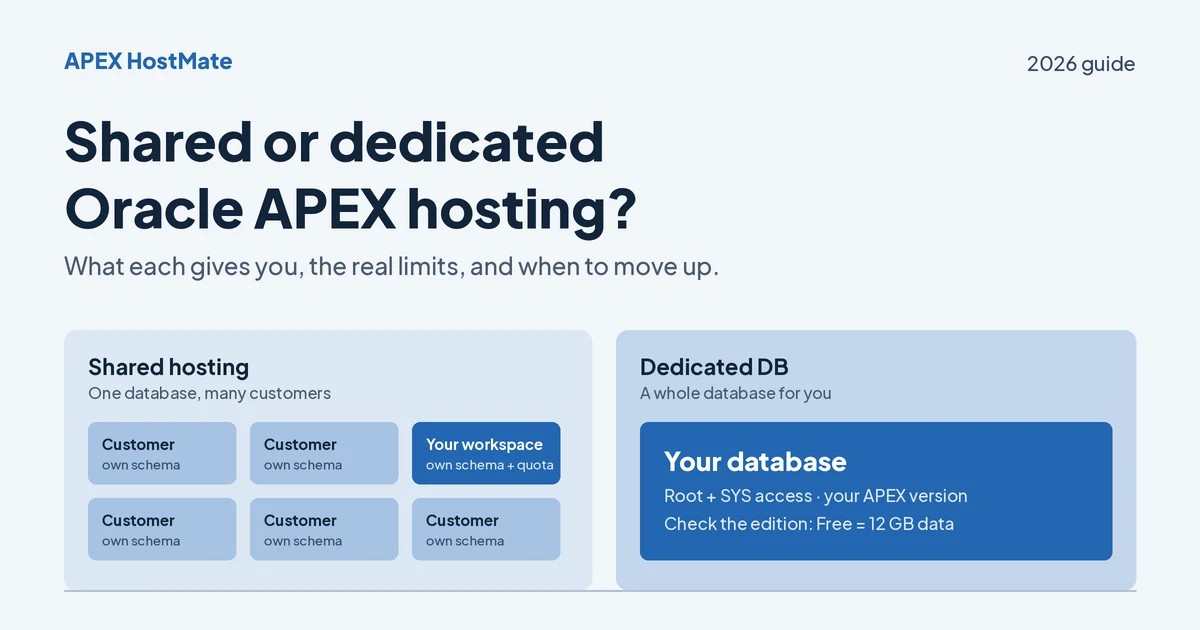
On a shared plan, one Oracle database serves many customers. Each customer gets their own APEX workspaces, their own database schemas and a reserved tablespace, so your tables and apps are separate from everyone else's. The provider runs the database, ORDS, upgrades and backups.
What you control: your workspaces, your applications, the objects in your schemas, and usually your own domain and SSL.
What you do not control: the database itself. You do not get SYS or DBA access, you cannot change database parameters, and the APEX version and upgrade dates are set by the provider. Some packages and privileges are restricted so that one customer cannot affect another.
How resources are shared: CPU and memory belong to the whole server. To keep things fair, providers set per-plan limits, typically on:
- database storage (tablespace size)
- the number of workspaces
- concurrent database sessions
- web-service or REST requests per day
These limits are what you are really buying, so read them before the price.
What dedicated DB hosting is
On a dedicated plan, you get a whole Oracle database on its own virtual or physical server. Nobody else's queries run on it. Dedicated plans usually include root access to the server and SYS access to the database, and you choose when APEX is upgraded.
What you control: almost everything. Database parameters, users and privileges, scheduler jobs, extra software on the server, the APEX version and the upgrade timing. Unlimited workspaces and schemas are normal, because the whole database is yours.
What you take on: with control comes responsibility. On a managed dedicated plan the provider still patches and backs up the server, but changes you make as root or SYS are yours to own.
Check the database edition. This is the detail most comparisons skip. Some dedicated APEX offers, ours included, run Oracle AI Database 26ai Free, which costs nothing to license. Oracle limits the Free edition to two CPU cores, 2 GB of RAM and 12 GB of user data, even if the server has more; beyond 12 GB, inserts fail with ORA-12954. A bigger server still helps the web tier, file storage and anything else you run on it, but the database itself stays within those limits. If you need more than 12 GB of data or more database memory, you need Enterprise Edition, which some providers sell as a separate tier.
Shared vs dedicated, side by side
| Shared hosting | Dedicated DB hosting | |
|---|---|---|
| Database | One database, many customers | A whole database for you |
| Isolation | Separate workspaces, schemas and tablespace; shared CPU and memory | Your own server; nobody else's load |
| Access | Your schemas only; no SYS, DBA or server login | SYS and usually root access |
| APEX version | Set by the provider, upgraded for everyone | You choose the version and the timing |
| Workspaces and schemas | A fixed number per plan | Usually unlimited |
| Typical limits | Storage quota, concurrent sessions, daily web requests | The server size and the database edition (Free: 2 cores, 2 GB RAM, 12 GB data) |
| Performance | Good for most business apps; can vary with the server's overall load | Predictable; sized to you |
| Maintenance | Fully done by the provider | Done by the provider, but your own changes are yours |
| Setup time | Minutes, often automatic | Hours |
| Typical price (public lists, Oct 2026) | about US$7–60 a month | about US$65–260 a month |
Prices vary with storage, server size and region, so compare like for like: storage, sessions and the database edition, not only the monthly figure.
When shared hosting is the right choice
Shared hosting suits most first production deployments:
- Internal tools, portals, booking and inventory apps for a small or mid-sized business
- A freelancer or agency delivering an app to a client, on the client's own domain
- Moving off apex.oracle.com, which Oracle does not allow for production use
- Teams with no DBA, who want patching, upgrades and backups done for them
- Apps whose data fits comfortably in a few hundred megabytes to a couple of gigabytes
Signs you have outgrown it
- You keep hitting the storage quota. Your data grows faster than you can archive it, and plan upgrades only buy a few months.
- Users see slow pages at busy times, and your own SQL is already tuned.
- Sessions or daily web requests run out. Users get errors at peak hours, or integrations stop late in the day.
- You need a privilege the provider cannot grant on a shared database: SYS access, your own scheduler setup, database parameters, extra server software.
- A client or regulator asks for an isolated environment, where no other customer's data shares the database.
One of these alone is often fixed by a larger shared plan. Two or more usually mean it is time for a dedicated server.
When dedicated hosting is the right choice
A dedicated database server earns its higher price when:
- Dozens of people use the app at the same time all day, such as an ERP, hospital or logistics system
- You need SYS or root access: custom database parameters, your own backup tools, extra software on the server
- You want to choose when APEX is upgraded, and test each release on your own schedule
- You run many workspaces or schemas, for example one per client or one per environment
- A contract or regulation requires that no other customer shares your database
When it is overkill
Dedicated is not automatically better. For a small app it means paying several times more for capacity you do not use, and taking on decisions about parameters and upgrades that a shared plan makes for you.
And remember the edition. If your data is heading well past 12 GB, a dedicated server on the Free edition will not solve it; you need Enterprise Edition. Ask the provider which edition each tier runs before you upgrade.
Moving from shared to dedicated
Starting on shared does not lock you in. An APEX app is defined in the database, so it moves between servers without a rewrite:
- Export the applications from App Builder, or with SQLcl for scripted exports.
- Export the schema with Data Pump, which carries your tables, data, packages and other objects.
- Import both on the new server. Make sure its APEX version is the same as or newer than the old one.
- Check the details that live outside the app: workspace users, static files, web credentials, REST modules, scheduler jobs and email settings.
- Point your domain at the new server and test before switching users over.
For most business apps the move takes a few hours, much of it testing. A short read-only window, or doing the final data copy outside working hours, avoids losing any changes made during the move.
Frequently asked questions
Is shared Oracle APEX hosting safe for production?
Yes, for most business apps. Each customer has separate workspaces, schemas and storage, and the provider handles patching and backups. Check how often backups run, how long they are kept and how a restore is requested.
Can other customers see my data on a shared server?
No. Your data lives in your own schemas, and other customers' workspaces have no access to them. They do share the server's CPU and memory, which is why plans set limits on sessions and requests.
How many users can a shared plan handle?
It depends on the plan's concurrent-session limit and on how heavy your pages are. As a rough guide, small plans suit a handful of people at once and larger plans a few dozen.
Do I need my own Oracle licence for dedicated hosting?
Not if the plan runs Oracle AI Database Free, which has no licence cost but has the limits described above. For Enterprise Edition, ask whether the licence is included in the price.
Can I start on shared and move to dedicated later?
Yes. Export your apps and schemas from the shared plan and import them on the dedicated server, as described above. Many providers do the move for you.
The bottom line
Pick shared hosting when you want a managed, low-cost home for an app with modest data and traffic. Pick dedicated when you need control, isolation or room to grow, and check the database edition before you assume a bigger server means a bigger database.
If you are unsure, start small. Moving up later is an export and an import, not a rebuild.
APEX HostMate offers both: Oracle APEX shared hosting from US$11 a month with automatic plan changes, and Dedicated DB hosting with root access and your choice of APEX version. Compare all plans, or ask us to move your app at no cost. For a wider view, including Oracle Cloud and running APEX yourself, see Oracle APEX hosting options compared.
Sources
Checked in October 2026. Limits change, so confirm against the current page before relying on a number.
- Oracle AI Database Free: licensing restrictions — two cores, 2 GB RAM, 12 GB of user data, ORA-12954
- Oracle: Free APEX Evaluation Service — apex.oracle.com is for demonstration only; no production applications
- Managed hosting price ranges: public price lists of several Oracle APEX hosting providers, October 2026